
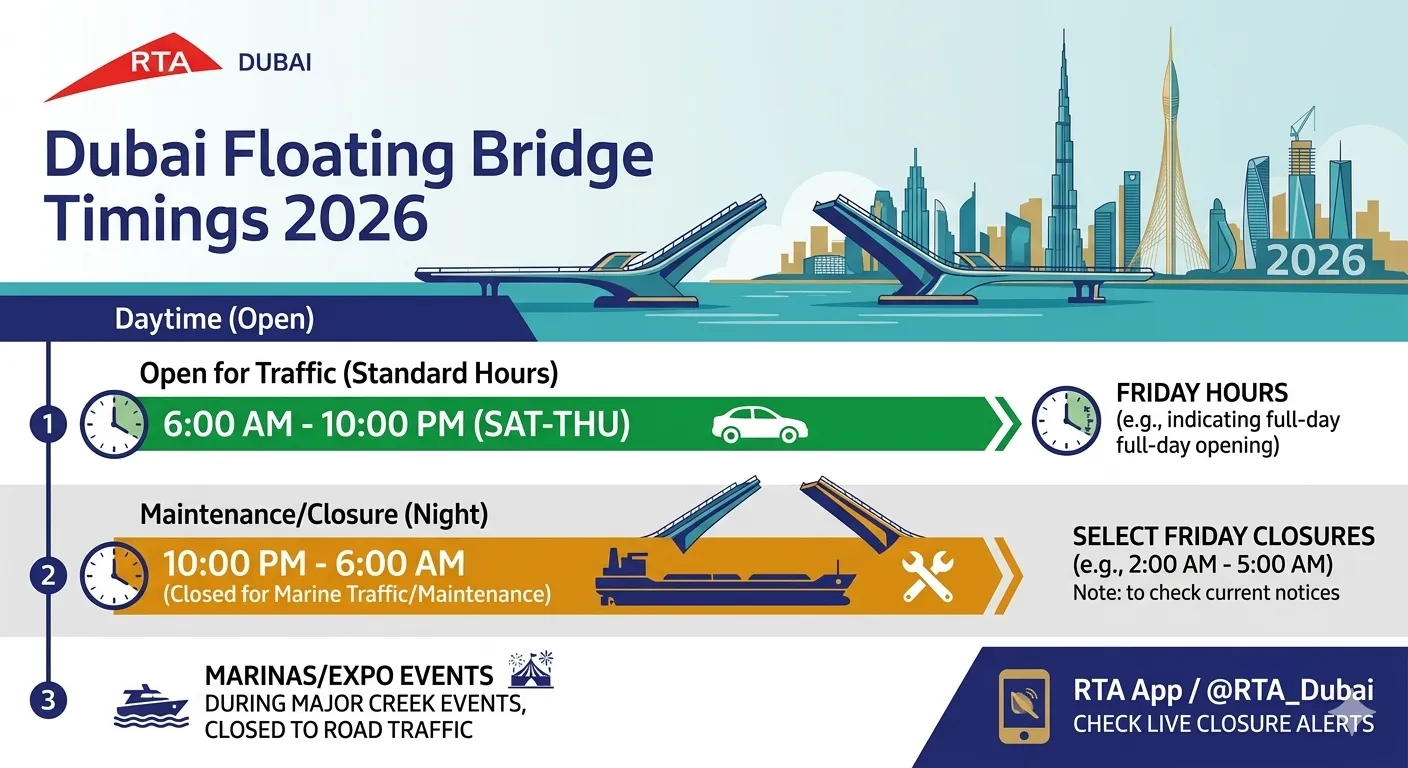
Floating Bridge Dubai Timings 2026 – Complete Guide to Operating Hours & Traffic Flow
The Floating Bridge is one of Dubai’s most ingenious engineering marvels. Spanning Dubai Creek, it connects the historic districts of Bur Dubai and Deira, appearing to float gracefully on the water. If you are a daily commuter or a visitor planning to cross the creek, knowing the Floating Bridge Dubai timings is essential – because traffic flow changes depending on peak hours. This guide covers everything: operating hours, directional closures, history, design, and how to contact the RTA for the latest updates.
1. What is the Floating Bridge?
The Floating Bridge (also known as Al Maktoum Bridge? No – that’s a different bridge. The Floating Bridge is officially named Dubai Floating Bridge and is located near Al Shindagha. It is a permanent structure that uses pontoon technology to “float” on Dubai Creek. Opened in 2007, it was built to ease traffic congestion on other creek crossings like Al Maktoum Bridge and Al Garhoud Bridge. The bridge has six lanes – three in each direction – but during peak hours, lanes can be reversed to accommodate heavy commuter flow.
Important correction: Unlike what some outdated articles claim, the Floating Bridge is not a temporary structure used only for events. It is a permanent bridge with regular daily operations, though occasional closures happen for maintenance.
2. Floating Bridge Dubai Timings – Current Operating Hours (2026)
The Floating Bridge operates 24 hours a day, 7 days a week – but with directional closures during rush hours to manage traffic. Standard timings are as follows:
| Direction | Normal Operation | Peak Hour (Morning) | Peak Hour (Evening) |
|---|---|---|---|
| Bur Dubai → Deira | Open | Closed (6:00 AM – 9:00 AM) | Open |
| Deira → Bur Dubai | Open | Open | Closed (5:00 PM – 8:00 PM) |
Summary:
Morning peak (6:00 – 9:00): Only traffic from Deira to Bur Dubai is allowed. Bur Dubai to Deira is closed.
Evening peak (17:00 – 20:00): Only traffic from Bur Dubai to Deira is allowed. Deira to Bur Dubai is closed.
Outside peak hours & weekends: All six lanes open in both directions (3 lanes each way).
Friday & public holidays: Usually no directional closures – full access all day.
Note: Timings are subject to change during Ramadan, national holidays, or special events. Always check the RTA’s official channels for real‑time updates.
3. Directional Traffic Flow (Reversible Lanes Explained)
The Floating Bridge uses a reversible lane system managed by the RTA. Electronic overhead signs indicate which lanes are open. Here is how it works:
Normal mode (off‑peak): Three lanes Bur Dubai → Deira; three lanes Deira → Bur Dubai.
Morning peak (6:00 – 9:00): The bridge becomes one‑way from Deira to Bur Dubai. All six lanes carry traffic toward Bur Dubai.
Evening peak (17:00 – 20:00): The bridge becomes one‑way from Bur Dubai to Deira. All six lanes carry traffic toward Deira.
This system reduces congestion dramatically during the busiest commute hours. If you try to go the wrong way, you will be stopped by RTA barriers or police – so pay attention to the signs.
4. History of the Floating Bridge
The idea of a floating crossing over Dubai Creek dates back to the 1960s, but it wasn’t until the early 2000s that the project gained momentum. Construction began in 2005 and was completed in 2007. The bridge was officially inaugurated in 2009 after extensive testing. Its primary purpose was to relieve pressure on Al Maktoum Bridge and Al Garhoud Bridge, both of which suffered from severe daily traffic jams.
In 2011, the Floating Bridge underwent major maintenance and was closed for several months. Since then, it has operated reliably, with only short‑term closures for technical inspections or special events.
5. Design & Engineering Specifications
The Floating Bridge is one of the largest floating bridges in the world. Here are the key numbers:
Total length: 1,600 meters (approx. 1.6 km)
Width: 20 meters
Number of lanes: 6 (3 each direction, but reversible)
Hourly capacity: Up to 6,000 vehicles per hour
Pontoon structure: 10 steel pontoons, each weighing approximately 5,000 tons
Mooring system: Heavy chains and anchors hold the pontoons in place
Tide adaptability: Pontoons rise and fall with the tide – at low tide, the bridge rests on the creek bed; at high tide, it floats
Pedestrian walkways: Dedicated paths on both sides, allowing people to walk across and enjoy views of Dubai’s skyline
The bridge also features decorative lighting that illuminates the creek at night, making it a popular spot for evening walks and photography.
6. Significance of the Floating Bridge
The Floating Bridge is more than just a traffic solution – it has become a Dubai landmark.
Traffic relief: It reduced congestion on other creek crossings by an estimated 30% within its first year.
Community connection: It links Bur Dubai (including Al Fahidi Historical District) with Deira (Gold Souk, Spice Souk), making it easier for residents and tourists to move between the two sides.
Tourist attraction: Visitors often come to see the unique floating design and walk across the pedestrian paths.
Event venue: The bridge has hosted parts of the Dubai Marathon, National Day celebrations, and even fitness events during the Dubai Fitness Challenge.
Media appearances: It has been featured in international TV shows, including BBC’s “Top Gear” and various travel documentaries.
7. Events That Have Used the Floating Bridge
While the bridge is permanent, it has been temporarily integrated into several major events:
Dubai International Boat Show (March): The bridge served as a viewing platform and connection point for exhibits on both sides of the creek.
Dubai Shopping Festival (December–January): The bridge was decorated and used as a pedestrian route between shopping zones.
Dubai Fitness Challenge (November): The pedestrian walkways hosted group yoga and walking challenges.
UAE National Day (December 2): The bridge becomes part of the celebration with lights and flags.
For these events, Floating Bridge Dubai timings may change – sometimes closing to vehicles temporarily to allow pedestrian access. Always check event schedules.
8. How to Contact RTA for Inquiries
If you need the most current information about closures, timings, or special usage, contact the Roads and Transport Authority (RTA) directly.
Website: www.rta.ae
Phone (customer service): 800 90 90 (toll‑free within UAE)
Email: info@rta.ae
RTA Smart App: Download from iOS/Android – live traffic updates
Social media: @RTA_Dubai on Twitter/X and Instagram
You can also ask event organizers if they plan to use the Floating Bridge for their event – they usually coordinate with RTA and will have specific timing details.
9. Frequently Asked Questions
Q: Is the Floating Bridge open 24 hours?
A: Yes, the bridge is open 24/7, but directional closures apply during peak hours (morning 6–9 and evening 5–8). Outside those hours, all lanes are open.
Q: Can pedestrians use the Floating Bridge?
A: Yes. There are dedicated pedestrian walkways on both sides, open at all times. Walking across offers great views of Dubai Creek.
Q: Is the Floating Bridge free to use?
A: Yes, there is no toll (unlike Al Maktoum Bridge, which has Salik toll gates). The Floating Bridge is completely free for vehicles and pedestrians.
Q: Why does the Floating Bridge close in one direction during peak hours?
A: To manage traffic flow efficiently. During morning rush, most commuters travel from Deira to Bur Dubai; in the evening, the opposite. Reversible lanes double the capacity in the busy direction.
Q: What happens if I try to drive the wrong way during peak hours?
A: RTA places physical barriers and electronic signs. Police may also be present. You will be turned away or fined.
Q: Are there any planned closures in 2026?
A: For the most up‑to‑date information, check RTA’s website or call 800 90 90. Routine maintenance closures are announced in advance.
Q: Can I cycle across the Floating Bridge?
A: Cycling is not officially permitted on the pedestrian walkways. Cyclists should use alternative creek crossings like Al Shindagha Tunnel or Business Bay Bridge.
Q: Is the Floating Bridge the same as Al Maktoum Bridge?
A: No. Al Maktoum Bridge is a different crossing with Salik toll. The Floating Bridge is located further north, near the Creek Park area.
Q: Does the Floating Bridge close during bad weather?
A: In extreme conditions (e.g., storms or very high tides), RTA may close the bridge temporarily for safety. Check the RTA app for live alerts.
10. Final Tips for Drivers
Plan your route – Use Google Maps or Waze, which incorporate real‑time lane closures.
Avoid peak hour wrong‑way attempts – Save time by using Al Garhoud Bridge or Al Shindagha Tunnel as alternatives if you need to go against the flow.
Check RTA app before leaving – Last‑minute changes can happen.
Pedestrian walkways are best enjoyed during off‑peak – Morning or evening walks are beautiful, especially at sunset.
Respect the reversible lane signs – They are electronic and change automatically. Do not rely on memory.
Conclusion
The Floating Bridge Dubai timings are straightforward once you understand the reversible lane system. Open 24/7 with directional closures during morning (6:00–9:00) and evening (17:00–20:00) rush hours, this engineering marvel remains a vital link between Bur Dubai and Deira. Whether you are a daily commuter, a tourist wanting a scenic walk, or an event organizer planning to use the bridge, this guide gives you everything you need.
For the latest updates, always contact the RTA at 800 90 90 or visit rta.ae. And for more practical guides on Dubai’s roads, utilities, and services, keep visiting https://www.khaleej2uae.com/ – your trusted local resource.